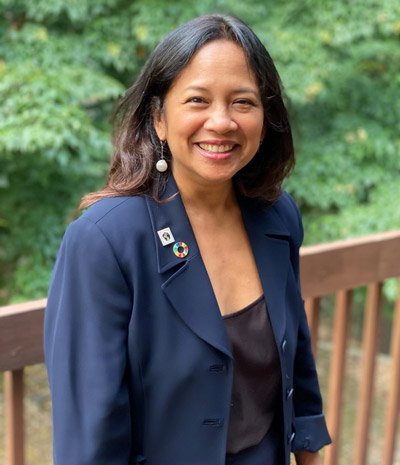
Tess Mateo’s eyes light up when she describes her first job, a paper route as a 12-year-old seventh grader in Troy, and the life-changing revelation that came with it.
“I learned that timing is everything,” says Mateo, a senior adviser to AQAL Capital in Munich, Germany. “I worked in November and December, and I would get these huge Christmas tips. And then I’d tell my friends how great the paper route was and they’d start in January (and) February, and didn’t get the tips and make as much money as I did.”
Today, Mateo invests in space companies providing earth observation data, innovative food waste technologies, fintechs, and new inventions that will lower the cost of solar energy.
So how did she make the leap from that paper route to what is now a career as a successful entrepreneur, self-described “impact/sustainability investor,” and green economy visionary?
It all began with her parents.
“My dad was a doctor and my mom was a medical technologist,” Mateo says. “They came from the Philippines, and if you wanted to go to America your golden ticket was to study medicine — and so that’s how they both came.”
Her parents both started their careers in Boston but met in Ohio, which is where Mateo was born. The family then moved to downtown Detroit, but left for the suburbs of Troy after the 1967 riots.
“It was all just farmland,” Mateo says of Troy. “Rochester Road and Livernois were like two lanes (each), and when you went north of 20 Mile, it was dirt roads.”
While attending Smith Middle School, Mateo delivered newspapers for the Troy Eccentric. She also developed into an accomplished athlete. “I set the record in 1979 for the 70-meter sprint, which was tied in 2016, and held four records at one time,” Mateo says of her middle school years.
She went on to attend Troy Athens High School, where she graduated in 1984. During high school, she was elected class president and homecoming queen, and organized the first 24-hour dance marathon in Michigan for muscular dystrophy. As a result, she was invited to present a check to Jerry Lewis, who served as host for numerous fundraisers centered on combatting the disease.
During high school, Mateo held an array of side jobs both at the Somerset Collection and Oakland Mall, including stints at Saks Fifth Avenue, Bonwit Teller, Gucci, Alfred’s Restaurant, Baker’s, and Chandler Shoes.
“I started out when I was 12 as a teen model for Bonwit Teller and Saks, and then became a stock girl at 14, and then a salesperson at 16,” she shares.
Following high school, she intended to follow her parents into medicine, and attended the University of Michigan in Ann Arbor.
“I always loved dissecting and wanted to be a surgeon. While I did immunology research and finished my biology degree in my sophomore year, Ann Arbor was too much fun to leave — so I added a psychology degree and planned to take the MCATs (Medical College Admission Test) the following year.”
With a lighter course load, Mateo worked as a bartender at Rick’s American Café in Ann Arbor and became a collegiate entrepreneur.
Her friend, David Walters, was selling boxer shorts on football game days with a little off-replica “M,” to avoid paying the licensing fee. “Madonna had started the boxer shorts craze when she wore them over leggings in ‘Desperately Seeking Susan,’ ” Mateo explains.
Tapping her earlier life in retail, she boasted to Walters she could double his sales. Laughing, he said he would make her a partner if she succeeded.
Moving quickly, Mateo persuaded gift stores to take the boxer shorts on consignment. When they became hot graduation and Father’s Day gifts, stores clamored for more. Impressed, Walters made Mateo a Colorworx co-owner and the company became “the first to sell college-logo boxer shorts in department stores, locally at Jacobson’s, and then nationally at Hudson’s,” she says.
To learn how offices operated, she joined Kelly Services in Troy to “temp,” and secured a public relations internship pitching stories and press releases.
As demand for the boxers grew exponentially, she hired her sorority sisters to sell the merchandise on game days, and sales grew from dozens to thousands. At the same time, she started a new child psychology research project.
As she attended spring classes the following year, her career trajectory took a sudden turn.
“I dropped a curling iron on my eye about a month before the MCATs, and it singed my eyeball. I had to go home and lie in bed with patches on my eyes, and I couldn’t move while it was healing. I couldn’t see for about a month.”
The doctor treating her said she was more animated when she was describing boxer shorts than talking about becoming a doctor. Taking the MCATs later meant she would start medical school after her peers, so she decided to study economics.
Luckily, her Lotus 123 spreadsheet skills were in great demand and General Motors hired her that summer.
“In spring of my senior year, I attended my first Association of Collegiate Entrepreneurs in Washington, D.C., and was selected to represent the United States at the first global meeting of young entrepreneurs at 10 Downing Street in London,” Mateo recalls.
“After the success of Live Aid, we wanted to organize something impactful, and came up with the idea of holding concerts on at least one college campus on each continent to raise funds for AIDS, which was then a cause that desperately needed immediate support.”
Mateo moved to New York City to explore producing the global music fundraiser, and successfully pitched the idea to the “godfather of disco,” Mel Cheren, who co-founded West End Records and helped start Paradise Garage, a popular gay discothèque.
Upon learning that corporations couldn’t sponsor campus concerts, Mateo helped Cheren with 24 Hours for Life, a campaign whereby nightclubs would donate their door receipts to AIDS.
When Mateo bumped into singer and U.S. Ambassador of Health Dionne Warwick in an elevator and excitedly pitched 24 Hours for Life, the singer was so impressed she suggested merging it with “That’s What Friends are For,” her three-day AIDS benefit gala weekend based off one of her hit songs, which had been written by Burt Bacharach and Carole Bayer Sager.
“As special events coordinator, I had to find and connect sponsors and talent,” Mateo says. “On a newsstand, I saw a list of New York City’s most powerful people. I thought, why not call them and invite them to lunch with Frank Sinatra, who was Dionne’s close friend, as they shared the same birthday on Dec. 12?
“A trick I learned from my Kelly girl temp work was to call someone’s office after 5:30 p.m., as their assistants had likely left for the day. In those days, oftentimes the head person would answer the phones. I was surprised so many would donate $25,000 to meet Frank. I was in my early 20s, and clueless to New York City’s corporate hierarchy. But we were successful, and throughout this process folks thought I knew all these powerful people.”
It helped that Warwick’s record label, Arista Records, and its founder, Clive Davis, were supportive of raising money for the gala weekend.
“I was invited to all of these events, and I remember one time shooting pool with my colleagues when Malcolm Forbes appeared and joined us,” Mateo says. “Everyone was trying to figure out who was this girl from Michigan?”
Long story short, through her cold calls, introductions, and recruitment efforts, combined with Warwick’s reach, multiple stars performed throughout the weekend, including Warwick, Sinatra, Sammy Davis Jr., Whitney Houston, Gladys Knight, Cyndi Lauper, Mary Wilson, Patti Labelle, Tony Orlando and Dawn, and many others.
Following one year in the entertainment world, which she enjoyed but grew tired of, Mateo joined Indevo, a Swedish consulting firm, as an associate consultant. Two years later, in 1992, she landed another consulting job, this time with Coopers & Lybrand.
“I was working long days for C&L, restructuring a company, and my team wondered why I was never available to work late on Thursdays,” she recalls.
As Mateo explains, “if you worked at Saks Fifth Avenue for 10 years, you could get a lifetime 30 percent discount. I’d already worked for Saks for almost nine years in Michigan, so when I moved to New York, I worked bridal once a week.”
But not for long. Once Mateo’s C&L client and Saks’ new owner, Investcorp, got wind about the lifetime discount, they pulled the plug. That’s when Mateo quit Saks and had her Thursdays back.
During her seven years at C&L, she worked on multiple restructuring projects in the retail, telecommunication, consumer products, and financial services industries.
In the mid-1990s, C&L sponsored her when she was accepted into Columbia Business School’s Executive MBA program. She started taking classes when her first child was 5 months old.
By the time she finished, she had another child, and C&L was in the midst of negotiating a merger with Price Waterhouse, which was Mateo’s cue to make another move.
“The merger between C&L and Price Waterhouse was a bit messy, so I left when a U-M classmate working at a venture capital firm recruited me to be the No. 2 at a startup, 1800GiftCertificate/IncentOne. We turned gift certificates into what are now ubiquitous gift cards and online incentives,” she says.
Mateo spent about two years with the startup, but was lured back to PwC by her former C&L mentor, Sam DiPiazza, when he was named PwC’s Global CEO.
“Some people referred to me as his chief of staff, but I never used that title. He recruited me back to work directly with him,” she notes.
The job at PwC was a turning point in Mateo’s professional life. Not only did she work with Di- Piazza for 10 years, but the job led to the next challenge in her career.
“Sam chaired the World Economic Forum and the World Business Council for Sustainable Development (WBCSD), among several other organizations, and I was responsible for his contribution to these strategic relationships. One WBCSD groundbreaking project, called Vision 2050, changed my life,” she says.
“Spooked by the global financial crisis, companies committed to sustainability feared that similar misplaced assumptions could create another crisis. It was the first collaborative global, multisector project on sustainability.”
Mateo says she co-chaired the Vision 2050 project on behalf of DiPiazza, and presented the outcomes to CEOs and government leaders around the world.
“That experience opened my eyes to new opportunities,” she says. “Vision 2050 laid out how an expected 9 billion people could live well within the resource limits of the planet by 2050.
“I’ve focused primarily on five of the 40 Vision 2050 ‘must haves,’ specifically clean energy, clean water, sustainable food, health, and women’s economic empowerment,” she says.
“Achieving Vision 2050 includes not only net-zero carbon emission goals, but also gender equality,” she says. “With Goldman Sachs estimating that $76 trillion will be spent in the coming decades to hit net-zero carbon emission goals, I’m working with others to help female entrepreneurs and women-owned businesses access and win at least 30 percent of that spend. You can go through various climate impact reports and triangulate geographically exactly where that money will be spent by sector.”
Today, the mother of three college graduates, including one from U-M, lives with her husband in the New York metropolitan area, where she often thinks about the state where she grew up, which Vision 2050 views as a highly desirable place to be in the years to come.
“With its Great Lakes, Michigan is less impacted by the climate chaos affecting other states — hurricanes, droughts, wildfires, and disease-carrying mosquitoes — so I’m bullish on the Mitten State,” she says. “In 2008, I started investing in real estate in Michigan, and I continue to invest now. I have several properties in Detroit, Ann Arbor, and a farm outside of Chelsea.”
After visiting more than 70 countries and all 50 states several times, Mateo says the character Dorothy in the “The Wizard of Oz” said it best: “There’s no place like home.”